A natural alternative to injections to soften forehead wrinkles and release tension in the upper face
Forehead wrinkles often appear when the frontalis muscle contracts repeatedly. Over time, and as skin elasticity decreases, these movements can mark the tissues and make expression lines more visible. Myofascial face yoga helps release tensions in the upper face by working more deeply on the fascia. Most face yoga methods focus on the skin or the muscles, without truly addressing the fascia that maintains these tensions. When I discovered myofascial work, I understood that these tissues play a key role in the formation of the lines — especially forehead wrinkles, those horizontal lines located on the upper face and often linked to tension in the frontalis muscle.
Today, this is the only approach that has truly transformed the appearance of my wrinkles and helped release long-lasting tension in the forehead area.
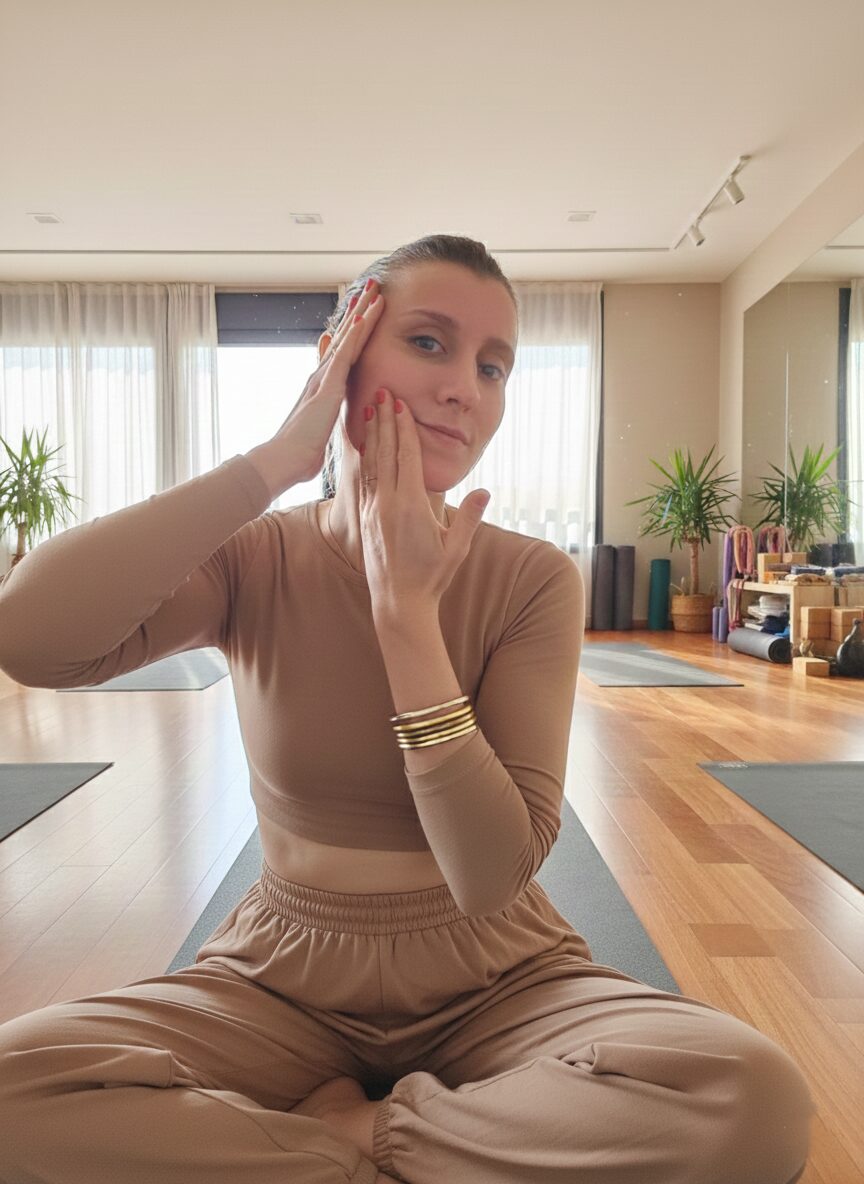
Wrinkles are a natural part of the aging process. Over the years, the skin evolves, tissues change, and the face gradually transforms. However, we do not all age in the same way. Some people develop more pronounced forehead wrinkles, while others have very few. Some notice a loss of definition in their facial contours over time, while others maintain more structured features.
Why is that?
The face is dynamic. It reflects our repeated expressions, our tension patterns, and the way certain muscles contract, sometimes even without our awareness. As we age and the skin loses elasticity, these repeated contractions gradually leave a deeper imprint on the tissues, and certain wrinkles begin to appear.
Forehead wrinkles, for example, often develop in people who frequently raise their eyebrows — when they are surprised, concentrating, or compensating for tension around the eyes. With repetition, the frontalis muscle can remain contracted. The skin then gradually starts to retain the imprint of these movements.
However, what I realized after testing different methods without real success on certain facial wrinkles is that the muscle does not explain everything.
Beneath the skin, there is a network of tissues called fascia. They surround the muscles, connect them together, and contribute to the overall structure of the face. When they lose mobility, they can maintain certain tensions in place. You can massage a muscle, try to relax or sculpt it… but if the surrounding fascia remains restricted, the tension will tend to return.
This is exactly what I observed on my own face.
WHY DO FOREHEAD WRINKLES APPEAR?
Forehead wrinkles are horizontal lines that appear on the upper part of the face. They form when certain facial muscles contract repeatedly, particularly when we raise our eyebrows.
The main muscle involved is the frontalis muscle, which lifts the eyebrows and is often responsible for the appearance of forehead wrinkles. These movements are part of our natural expressions: when we are surprised, concentrating, thinking, or trying to open the eyes more widely.
Over time, these repeated contractions can maintain tension in the forehead area. At first, forehead wrinkles only appear when the face contracts. But gradually, as skin elasticity decreases, these folds can mark the tissues and become visible even when the face is at rest.
However, the cause is not always purely local. In many cases, forehead wrinkles can also be influenced by tension located elsewhere in the face. Tension in the scalp, around the temples, or in certain areas of the forehead can maintain contraction in the frontalis muscle.
This is why working only on the frontalis muscle is not always sufficient. For some people, it can improve wrinkles if the tension mainly comes from this muscle. But in other cases, it is also necessary to work on the scalp, the temples, or certain areas of the upper face in order to release the tension that maintains this contraction.
This is precisely why I always take a global approach to the face, in order to identify where the tension truly originates and to work on the areas responsible for it.
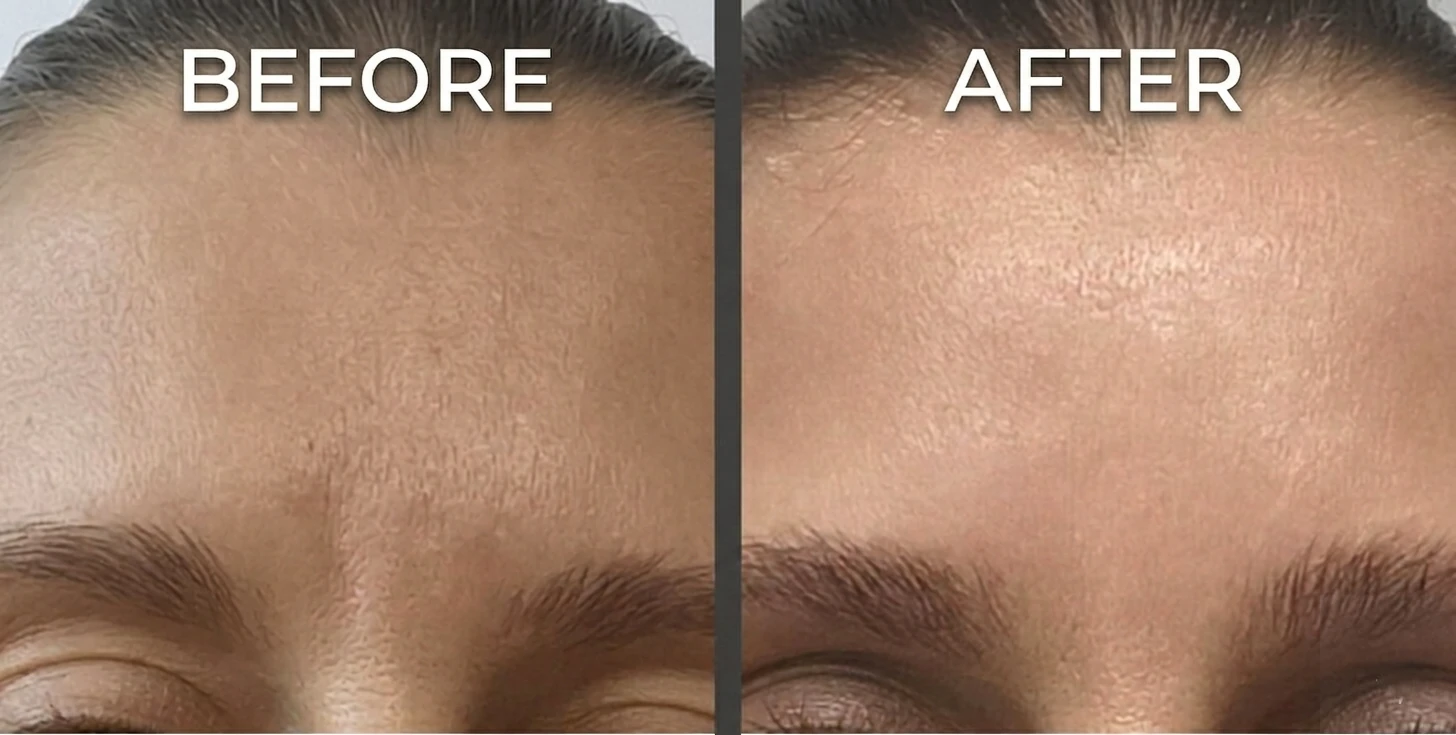
Here is the evolution of my frown lines before and after one month of myofascial work on the facial fascia.
Honestly, I was surprised myself, because after more than a year of testing different methods, it was the first time I observed a real change.
That is when I understood that working deeply on the fascia could truly release certain facial tensions — those involved in the formation of some wrinkles, particularly in the forehead area and between the eyebrows.
To understand how I arrived at this approach, we need to go back a little.
Over the years, my frown lines were becoming more and more visible, and it had become a real concern. Like many women, I wanted to know if it was possible to improve things naturally, without resorting to injections.
For more than a year, I experimented with different face yoga and massage techniques, both in France and abroad. Each time, I practiced them consistently for several months before testing a new method, convinced that consistency would eventually bring results. But the lines remained. At times, I even felt that the tension between my eyebrows and across my forehead had become even more pronounced.
I then discovered deep myofascial work. This approach was very different from everything I had tried before. It was no longer just about massaging the area between the eyebrows or stimulating the muscle responsible for the wrinkle, but about releasing tension deeper within the tissues and understanding which areas of the face were actually involved in this contraction — sometimes even higher, at the level of the scalp.
Gradually, the tissues began to regain mobility and the area between my eyebrows relaxed. This did not happen overnight, but over the weeks the release became visible and the appearance of my frown lines progressively improved.
That is when I understood something essential: the solution was not to multiply exercises to relax the muscle, nor to work only on the area where the wrinkle appears. To truly act, it was necessary to go deeper, at the level of the fascia, where tension can settle and persist.
Since then, this understanding has guided my entire practice and the approach I offer today.
Many people wonder how to reduce forehead wrinkles naturally, especially when they become more visible on the upper part of the face.
Forehead wrinkles generally appear when tension gradually builds in the forehead area. This tension may be linked to repeated expressions — such as raising the eyebrows — but also to contractions located in other areas of the face, particularly around the eyes, the temples, or the scalp.
To reduce forehead wrinkles naturally, it is therefore not always enough to work only on the area where the wrinkles are visible. In some cases, relaxing the frontalis muscle may be sufficient if the tension mainly comes from this muscle. But in other situations, it is also necessary to work on the scalp, the temples, or certain areas of the upper face that contribute to this contraction.
This is why myofascial facial work can be particularly effective. By acting on the fascia — the tissues that surround and connect the muscles — it becomes possible to release deeper tension and restore mobility within the tissues.
Gradually, as this tension decreases, the forehead area can relax and forehead wrinkles may become less pronounced.
This work requires consistency and a good understanding of the face, as each person presents different tension patterns. The goal is not to completely erase wrinkles, but to support the face in a more natural way by releasing the tension that contributes to their formation.

My approach is mainly based on myofascial facial work, a technique that acts on the fascia to release certain tensions and improve tissue mobility.
Facial muscles do not function independently. Unlike other areas of the body, they overlap and work together, surrounded by a network of fascia that connects and supports all the tissues. When tension builds in one area, it can impact other parts of the face.
This is why the origin of a wrinkle or sagging is not always located where it appears. Forehead wrinkles, for example, may be influenced by tension in the scalp or the temples. Similarly, a loss of firmness in the jawline is not always only linked to the cheek itself. It can also be influenced by tension in the lateral areas of the face, particularly in the masseter, but also in the neck — in the sternocleidomastoid (SCM) or the platysma — or even by posture when it pulls the tissues downward.
Several factors can therefore be at the origin of tension or sagging. That is why my work always begins with a precise analysis of the face: observing where tension is located, how the tissues move, and which areas are truly involved in the imbalance.
From this facial reading, I then build a tailored routine. I rely on specific protocols for each area, but they are never applied in the same way. Depending on the face, some techniques will be prioritized while others will be less necessary.
The goal is to offer targeted, coherent, and realistic work that can be integrated into daily life. Because it is not the number of exercises that makes the difference, but the accuracy of the movements and their consistency. Myofascial work relies on precise, slow, and deep movements to truly act on the fascia and restore mobility within the tissues.
It is this detailed analysis and this deep, precise work that allows for real and lasting change.

After more than ten years working in the cosmetics industry, an allergic reaction to a skincare product led me to question what I was applying to my skin. I then began searching for healthier and more respectful products, and that is when I discovered Ringana. At first, I simply wanted to better hydrate my skin with more natural products, without imagining the changes this would bring.
Over time, my skin rebalanced and my hormonal acne gradually disappeared. But as I approached my forties, certain wrinkles began to appear — especially frown lines and the first forehead wrinkles. I did not want to rely on injections. Face yoga then became a natural next step, allowing me to act where products cannot intervene: the muscles and the fascia.
I first practiced on myself for over a year, testing different techniques and observing how my face responded. Some brought relaxation or more radiance to my skin, but I did not notice any real change in my wrinkles. Then I discovered deep myofascial work. It is the only approach that truly transformed the appearance of my wrinkles, especially on my forehead and between my eyebrows.
Observing these changes on my own face made me want to go further. I chose to train in order to deepen this approach and support other women who want to reduce their wrinkles naturally and take care of their skin without injections.
I host online group sessions designed to work on specific areas of the face.
These sessions focus on forehead wrinkles and aim to release tension across the upper face using facial yoga techniques based on myofascial work. The goal is to improve tissue mobility and help the face appear smoother and more relaxed. We also look at how the scalp, temples, and surrounding areas influence the appearance of the forehead. These sessions help you understand the mechanisms behind forehead lines and how to work on them in a targeted and effective way.
Sessions are held in small groups to ensure a high-quality experience. New dates are released regularly.
Sign up to get notified when the next session opens.
Discover how deep work on the fascia can help release facial tension and reduce certain wrinkles, especially forehead wrinkles.
Not all faces age in the same way. In some people, expression lines are more pronounced; in others, the face tends to sag more; while others mainly develop fine lines. These different patterns provide insight into how facial tissues evolve over time.
In reality, a single face often shows several of these characteristics. That is why my work is not only about identifying a type of aging, but above all about observing how the face has evolved and which tensions have gradually developed.
Understanding this evolution makes it possible to approach wrinkles differently: no longer just as visible marks on the skin, but as the expression of tension or imbalance within the facial tissues.
Over the years, the skin gradually loses elasticity and collagen. It then more easily marks the folds that appear through repeated expressions: smiling, frowning, or squinting. Wrinkles are therefore a natural part of how the face evolves.
However, not everyone develops the same wrinkles or in the same areas.
Each face retains the imprint of repeated expressions and accumulated tension over time. Some people strongly contract their forehead when concentrating, others clench their jaw or tense certain areas of the face without even realizing it. Over the years, these repeated contractions progressively leave a deeper mark on the tissues.
Facial muscles are closely interconnected and surrounded by fascia that envelop the tissues. When tension develops in one area, it can maintain other areas of the face in a state of contraction. A visible wrinkle does not always mean that the cause is located exactly there. Forehead wrinkles, for example, can be influenced by tension located higher up, particularly in the scalp.
Understanding what is really happening within the tissues makes it possible to act more accurately: releasing tension where it forms, restoring mobility in the fascia, and working on the areas truly involved rather than only massaging the visible wrinkle.

Raising the eyebrows, squinting, smiling… These repeated expressions intensely engage certain facial muscles. Over time, when these muscles remain too frequently contracted, lines can become permanently set, such as forehead wrinkles or crow’s feet.
But this tension does not only concern the visible muscle. The fascia surrounding the muscles can also lose flexibility over time and keep the tissues in a contracted position.
This is why massaging only the muscle responsible for a wrinkle is not always enough. The tension can quickly return if the surrounding tissues remain restricted. The goal is therefore to release these tensions more deeply, at the level of the fascia, to restore mobility and allow the muscle to relax in a lasting way.

Over time, some facial muscles gradually lose tone and provide less support to the tissues. The skin is then more affected by gravity.
This can result in:
But this sagging is not only linked to a loss of tone. Tension present in certain areas of the face or neck can also pull the tissues downward and accentuate this effect.
The work therefore consists of restoring support to the face while releasing these tensions. Myofascial work helps restore tissue mobility and rebalance the areas of the face involved in this sagging.
Deep wrinkles appear partly due to the natural decrease in collagen and elastin, two essential components for skin firmness and elasticity.
Over time, facial tissues gradually lose support. Muscles and fascia can become more rigid or less mobile, which influences how the skin folds and marks.
Myofascial work then aims to restore mobility to the tissues and improve overall facial support. These practices support the aging process in a progressive way, without aiming to completely erase wrinkles.

Fine lines often appear when the skin lacks hydration or comfort. They can be influenced by different factors: environment, stress, diet, or an unsuitable skincare routine.
In these situations, manual myofascial work stimulates microcirculation and promotes better oxygenation of the tissues. The fascia regain flexibility and the skin may appear smoother and more radiant.
Combined with an appropriate skincare routine, this work helps improve skin comfort and revive its natural glow.
Deep work on the fascia helps release certain facial tensions and act sustainably on the appearance of wrinkles. After testing many different methods, this is the approach that truly transformed the appearance of some wrinkles on my face, especially on my forehead. If you would like to learn more about this approach, we can discuss it during a free consultation.

My method has been built through training, daily practice, and careful observation of my own face. By working on my wrinkles, I understood that the face cannot be treated in isolation.
For a long time, I focused on massaging facial muscles, trying to relax the most contracted areas. But it was by discovering the role of fascia — these tissues that connect and surround the different structures of the face — that I began to see real changes in my wrinkles. Myofascial work is the approach that has most transformed my face, particularly on my forehead.
Over time, I also understood that it is not necessary to work on all areas of the face every day. The practice remains consistent, but the areas are alternated to allow the tissues — and the fascia — time to release and soften.
My approach therefore consists of working with precision: focusing on fewer areas at a time, but in a more targeted way, with slow and deep movements that allow the fascia to regain flexibility and elasticity.
Gradually, I also understood that the skin, muscles, fascia, circulation, and lifestyle are closely interconnected. It is the balance between these different elements that allows for lasting and natural results.
Within this global balance, nutrition also plays an important role. Facial tissues, like all tissues in the body, need nutrients to maintain and renew themselves. Proteins help support muscles and tissues, while certain lipids contribute to skin flexibility and radiance. A balanced diet therefore helps tissues remain more toned and better support the skin.
This is why my support does not only consist of teaching face yoga exercises or working on fascia. During consultations, I also address lifestyle more broadly in order to understand what may limit — or on the contrary support — the effects of the work done on the face.
This global understanding then allows me to define a routine adapted to each face: which exercises to prioritize, how often to practice them, and certain lifestyle and nutrition recommendations.

Many people today consider injections or Botox for forehead wrinkles, as this area is often treated this way in aesthetic medicine.
Injections may appear as a quick solution to smooth forehead wrinkles. They work by limiting muscle contraction, which can reduce the appearance of lines.
However, by reducing the activity of certain muscles, they also modify the natural dynamics of the face. Over time, a less active muscle may lose tone, which can sometimes shift the issue toward a lack of support once the product wears off.
Injections also do not address certain essential aspects of facial aging, such as tissue quality, circulation, or fascia mobility.
Face yoga and manual myofascial work offer a different approach: they work with the muscles, fascia, and facial tissues to release tension, support areas lacking tone, and stimulate circulation.


In this guide, I share the key factors that influence skin radiance: diet, exercise, facial massage, skincare routine, and stress management. A holistic approach to supporting your skin every day.
I support you in naturally smoothing wrinkles and releasing facial tension through myofascial facial work. This approach is based on precise techniques that you can learn to reproduce at home, with the right guidance. I also offer personalized sessions where I work directly on your face.

A first session to assess your face and identify areas of tension linked to forehead wrinkles.
You will leave with:
a clear understanding of tension across the forehead,
the areas to focus on as a priority,
initial recommendations tailored to your needs.
Ideal to understand the origin of forehead wrinkles and know where to start.

A guided program over several weeks to reduce forehead wrinkles and achieve visible and lasting results.
I support you to:
build a routine adapted to your face,
learn how to perform it correctly,
stay consistent over time to see real results.
Ideal to progressively smooth forehead wrinkles through targeted work you can do at home.

A session during which I work directly on your face to release deep tension, especially across the forehead.
Using precise techniques, I help relax the muscles, improve their mobility and soften facial features.
The effects of this myofascial work can already be visible on certain areas from the first session.
For lasting results, this approach is more effective when followed over several sessions, combined with simple exercises to practice at home.
Ideal if you would like me to work directly on your face, with a personalized and targeted approach.

I have selected a few essentials that I use to support facial work: simple tools and skin-friendly products. The hands perform most of the work. Skincare supports skin quality, and tools simply complement this work.
How can you reduce forehead wrinkles naturally?
Many people today are looking for ways to reduce forehead wrinkles naturally, especially when these lines become visible even at rest. Forehead wrinkles are often linked to repeated contractions of the frontalis muscle, particularly when we frequently raise our eyebrows. Over time and with the decrease in collagen, these movements can gradually mark the tissues.
To act naturally, it is important to release the tension that maintains this contraction. Myofascial facial work allows deeper action on the tissues by restoring mobility in the fascia and helping the muscles relax. This is the approach that allowed me to observe the first changes in my own forehead after testing different massage methods without lasting results. As tension gradually decreases, the forehead can relax and the appearance of wrinkles may soften.
At what age should you start face yoga for forehead wrinkles?
Face yoga can be practiced at any age. Some people start around 25–30 to prevent the appearance of early wrinkles, while others begin later to release existing tension or support the natural changes of the face over time. The goal is not to stop aging, but to learn how to release tension and maintain tissue mobility, especially in sensitive areas like the forehead.
When can you see the first results on forehead wrinkles?
Results vary depending on each face, the level of tension present, and the consistency of the practice. Some people already feel a more relaxed forehead after a few sessions. To observe visible and lasting changes, several weeks of regular practice are usually needed, on average between two and three months.
Can face yoga replace injections for forehead wrinkles?
Injections and facial work do not act in the same way. Injections smooth wrinkles quickly by limiting muscle activity or filling an area. Face yoga and myofascial work act on muscle tension, fascia mobility, and tissue circulation. The goal is therefore different: to support the face in a more natural way, without freezing expressions.
Do you need to practice every day?
Regular practice is important, but it does not necessarily mean doing many exercises every day. In my approach, the idea is to focus on the areas truly affected by tension, with a realistic and adapted routine. Areas are often alternated to give tissues time to recover and avoid overworking them.
Can wrinkles worsen if exercises are done incorrectly?
Yes, it can happen. Certain exercises that are not adapted or performed with too much tension can reinforce contractions instead of releasing them. That is why it is important to understand the origin of the wrinkle and to also work on the fascia, rather than only stimulating the visible muscle.
Is myofascial work painful?
Myofascial work can sometimes feel slightly intense in areas where tension has been present for a long time, but it should never be painful. Movements are progressive and adapted to each face. Over time, tissues regain mobility and sensations generally become more comfortable.
What if I already have significant sagging?
Even when sagging is already present, it is possible to improve facial tone and restore mobility to the tissues through myofascial work. The goal is not to completely transform the face, but to support its evolution by acting on tension, muscular support, and tissue circulation.
Should you use tools like gua sha?
Myofascial facial work is mainly performed with the hands. They allow you to feel tension in the tissues and act precisely on the fascia. Some tools like gua sha can be used as a complement for facial drainage, but they do not replace manual work when it comes to releasing deep tension.
How does a personalized online session work?
A session always begins with a discussion to understand your face, your expectations, and your priorities. I then guide you step by step through adapted techniques that you can reproduce at home. The goal is to make you independent with a simple, clear, and personalized routine.
Why do forehead wrinkles appear?
Forehead wrinkles generally appear due to repeated contractions of the frontalis muscle when we raise our eyebrows, express emotions, or react to light. Over time, these repeated contractions can maintain tension in the forehead and gradually mark the skin, making wrinkles visible even when the face is at rest.
Would you like to reduce your forehead wrinkles naturally?
Many people today are looking for a solution to reduce forehead wrinkles naturally without injections. Deep work on the fascia helps address the tension responsible for these wrinkles. If you would like to discover how this approach can be adapted to your face, we can discuss it during a free consultation.
Be the first to receive the dates of upcoming online face yoga workshops, along with all the details to register.
Limited spots — small groups for high-quality guidance.

